

12 Angry Men

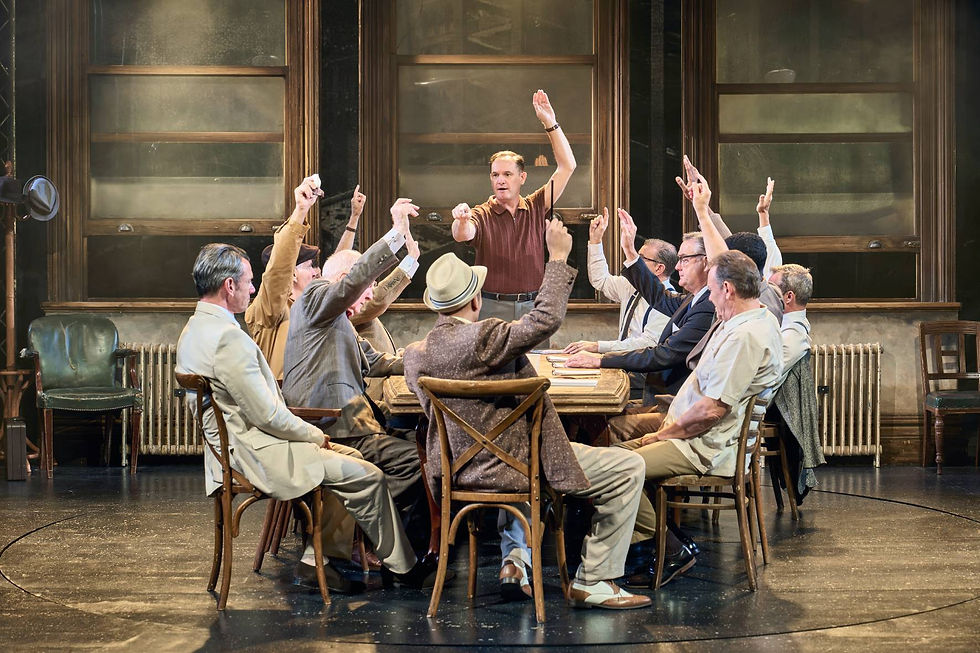
A masterclass in tension — the entire auditorium becomes the thirteenth seat at the table.
Reginald Rose’s Twelve Angry Men began life as a television play in 1954 before becoming the celebrated 1957 film starring Henry Fonda — still the version through which most people will know this remarkable story.
Its premise could hardly be more simple. Twelve jurors retire to consider their verdict in the trial of a young man accused of murdering his father. Eleven believe him guilty. One isn’t so sure.
From its opening moments at Darlington Hippodrome, however, the 900-plus-seat auditorium somehow becomes the thirteenth seat around that jury-room table.
Gray O’Brien takes the pivotal role of Juror 8 and inevitably carries the shadow of Fonda’s famous performance. Wisely, neither he nor director Christopher Haydon attempt to escape too far from Rose’s beautifully precise writing. Instead, O’Brien brings a quiet assuredness to his character’s uncertainty. He doesn’t know that the accused is innocent; he knows that he doesn’t know he is guilty. That distinction — the very essence of reasonable doubt — remains tangible throughout.
Opposite him, Bill Ward’s Juror 3 provides the other lynchpin upon which the evening’s emotions seesaw, as reason, personality, frustration and anger increasingly collide.

Haydon’s pacing is masterful. This is a genuine roller coaster which understands that tension isn’t created solely through raised voices. Extended, almost painfully prolonged silences are afforded every bit as much importance as the explosive flashes of anger. At times, an entire auditorium seems reluctant to breathe.
Michael Pavelka’s ingenious design contributes enormously. The jury table revolves so subtly that initially you question whether it has moved at all. Perspectives are constantly shifting and, just like the jurors, the audience is never allowed to settle comfortably into one position.
That applies intellectually too. From the outset it is tempting to think, “I know how I would vote.” Then point follows counterpoint, certainty becomes doubt and our own reactions are quietly challenged.
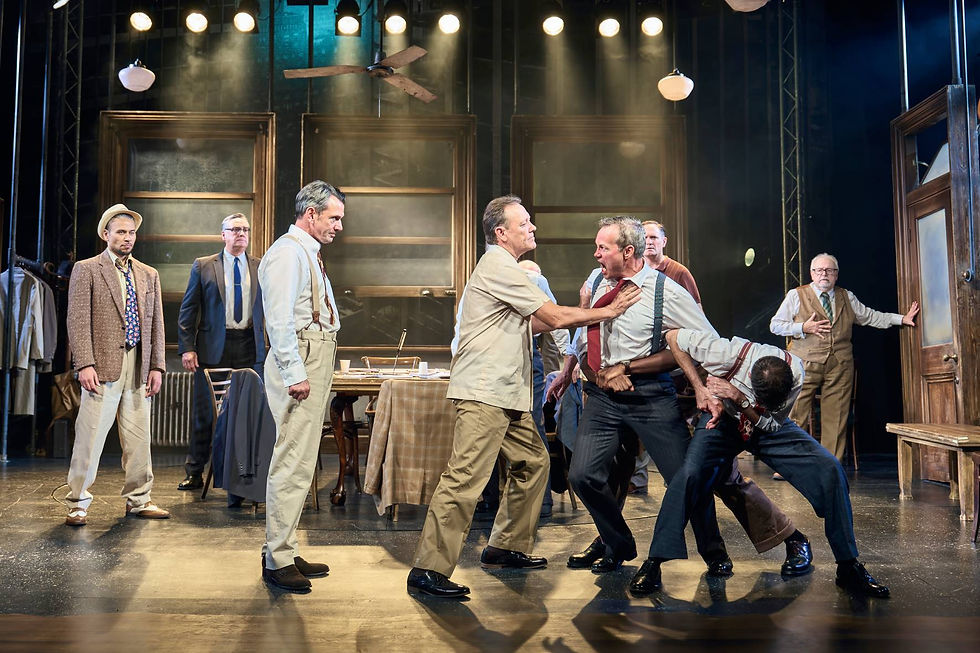
Perhaps most tellingly for a modern audience, it is the jurors’ prejudices rather than the legal principles which speak loudest across the decades. Today, social media can convene its own jury within minutes, where certainty frequently precedes evidence and those who shout — or type — loudest are not necessarily those with the rightful voice.
Being tried before a jury of our peers sounds reassuringly democratic, but those peers inevitably carry the same doubts, beliefs, prejudices and ideals as the rest of us. The strength of our justice system is therefore also open to the flaws within ourselves. Rose understood that in 1954. Seventy years later, it remains an uncomfortable thought.
But this is no history lesson. Haydon’s production is gripping, intelligent and superbly paced theatre, drawing an entire auditorium into that jury room and holding it there until the final moments.
The verdict? Twelve Angry Men remains utterly compelling — and this outstanding production makes a powerful case for seeing it live.
12 Angry Men is at Darlington Hippodrome until Saturday 10th October. Tickets from www.darlingtonhippodrome.co.uk or 01325 405405.


Comments